Monday, 7 April 2014
Erasmus exchange - Universidad de Murcia
It's been almost a year in the planning - longer if I consider that I have wanted to make an Erasmus staff exchange visit for the past three years - but finally I am here.
Why did I want to do this?
Well - firstly as a student of the language, it was a goal to aim for: to feel sufficiently fluent to be comfortable working (largely) in castellano and to be able to get by on my own in a strange city.
After 10 years of studying, I finally feel ready for the challenge!
Secondly, I have been following various Spanish and spanish speaking "professors" on Twitter for a number of years and have an impression that there is a lot of great practice here in Spain that it would be good to see first hand.
Thirdly, and specific to Murcia, I formed a connection with Linda CasteƱada some years ago when I attended the first PLE conference in Barcelona. She later helped me with one of my Spanish homework assignments by sending me a wonderful book she and her Head of Department - Maria Paz Prendes - had written about the University of Murcia's transition to a connected campus. What better place to come!
Finally, I know that Linda uses technology with her students and works with them to develop their Personal Learning Networks. Although she works with primary teachers in training rather than with social science students, as I do, I still thought this an ideal place to come and observe the similarities and the differences, to learn about some innovative good practice and generally have time to think about ways I could improve my own approach. And it's sunny!
So - Day 1: started off well being picked up by the lovely Maria del Mar in her impressive big white car in which I was whisked off to the palm tree lined campus at Espinardo. We were met by Linda and Manel Rives - the guest speaker for the first session - and what followed was a lot of kissing. Later I met the rest of Linda's team and her boss - and there was even more kissing! Well - because of the cultural differences I should say more accurately that there was a lot of fumbling as I first held out my hand, then realised that the two cheek kiss was the official protocol. I also learned, by the way, that loud "mwah" sounds are not de rigeur - in fact they might even be frowned upon - but I was much too embarrassed in my quaint English fashion to fully notice all the nuances of these exchanges.
Kissing over, I attended a really interesting workshop run by @manelrives in which he explained the many great learning opportunities to be had through mobile apps - and then led a workshop in which Linda's students found some and explained to one another how they thought they could be used in the classroom. (at least, I think that was what was happening - my castellano was flagging after an hour!)
The one slightly worrying moment came at the start when Linda's students presented their guest speaker. They had been charged with exploring his online identity to find out as much as they could about him and put this, along with any photos they could find on the web, into a charming Powerpoint presentation. Oh dear! It's my turn in the morning. (Note: I really must Google myself tonight!)
The rest of the afternoon was spent in my new temporary office - with aircon and wifi I'd kill for in my "4 star" hotel in the centre of Murcia. Linda ran through the week's itinerary of meetings and social events (I'm even going dancing one night as Maria is also an avid salsera) and I prepared my workshop for tomorrow. It will be in English as this is a bilingual class and English is compulsory. As a bonus, the University has a publicly accessible swimming pool (thanks again to Maria for the investigations) and I shall explore that tomorrow after the class.
I finished the day walking over to the tram stop for a pleasant ride back into the centre of Murcia. As I walked down a shady tree lined boulevard back to my hotel, I really felt that this was living my dream! If an Erasmus exchange is about anything, it must be about a short, intense, immersive experience of a different culture and whilst I "know" Spain as a tourist and holidaymaker, being here as "prof" and student rolled into one is giving me exactly that.
Labels:
digital literacy,
erasmus,
PLE,
student engagement,
technology
Sunday, 6 April 2014
#digilit The experiment draws to a close
A year ago I was involved in two MOOCs - #oldsmooc and #octel - which helped me think about the redesign of my "traditional" study skills module to transform it into a more contemporary digital skills module. At the same time I volunteered to take part in a pilot of a Scale Up classroom environment. Just to add another variable to the mix, I also volunteered my module to be part of a Changing the Learning Landscape bid that the university was making to fund student mentors in classrooms
I have been blogging about this for the past year here on The Virtual Leader and also over on the module team blog Not To Scale
So now the great experiment is drawing to a close and the students have submitted their module evaluations.
There is much to learn from this. Designing a module to teach 21st century skills is one thing, designing it to be taught within a brand new teaching environment is another. The environment we teach in really does shape the how and the what of the curriculum. For this reason the changes made to the module were complex and complexity brings with it unintended consequences.
Some exciting and unlooked for outcomes for me are that a) more of the wider course team now want to teach in the Scale Up classroom b) there is general acceptance from the wider course team that digital literacy skills need to be embedded across the curriculum, so the module will likely disappear in 2015 and c) there is a lot of support within the team for greater use of student mentors in classrooms.
The last few weeks of the module have been particularly enjoyable as students have been working on their final group projects. My role has been much more that of a support for the groups and the classroom environment really lends itself well to this style of teaching. I feel the students and I are able to develop a relationship where I can see their progress and understanding and they understand the point of what we have been teaching them for the past 6 months!
I have now finished marking their final research projects and so it is possible to judge the extent to which digital literacy skills have been developed.
The first option they were given was to design a short research questionnaire using Survey Monkey or Google Forms. Option 2 was to use a platform such as pinterest or Tumblr to curate various resources relating to their particular research interests.
They also had to complete a worksheet in which they outlined the preparatory research they had carried out on their topic, reference their sources and discuss their design choices and any ethical issues.
I am generally very pleased with the majority of submissions which do demonstrate that they have managed to pick up the rudiments of Harvard referencing, can find their way around Google Drive and other web based tools and find articles, websites, ebooks and the like to support their work.
There is even the beginning of an understanding of research skills which, whilst many of the students don't see the point of them (according to their module feedback) we HE teachers will see as welcome news.
I will certainly be running at least one final iteration of this module. I have learned much about how to make bext use of the room, the technology and also what sort of assessment best aligns with the learning objectives for the module. Next year, project groups will be set up much earlier and there will be opportunities for formative feedback in Term 1, with the final project itself having more depth and breadth.
I will be sorry in one sense to see this module go altogether and will continue to be anxious about how well we can embed essential skills into the wider curriculum, but if that does begin to happen, the learning curve we have been through in the past few years will have been worthwhile.
Thursday, 20 March 2014
Learning from my students - and a Twitter tale....
I am reviewing students' final reflective assignments at the moment (on the theme of team work) and I noticed a number of them referring to a specific model (http://www.team-diagnostics.com/the-model.php) which I had not seen before.
It is a really interesting model developed by Hackman and building on his earlier work on Team Effectiveness, which I do refer to in my module.
I assumed students had found this by googling the name Hackman, but I later realised that I had myself re-Tweeted a link to the model (without actually reading the article - as a "save for later" read) and simultaneously posted it on my LinkedIn feed.
I now realise that those students who used it are the same ones who follow me on Twitter and Linked In.
On a related note: as I have been marking, I have had a slight sense of irritation that so few of the resources I carefully curate at the start of the module ever actually end up in the students' reference lists - preferring as they do to google and use whatever popular business style websites pop up on top.
However, there are also some instances where they have managed to find articles that really add depth to the discussion and which I have found develop my understanding of the subject.
This lends weight to a) my intention next year to include NO RESOURCES WHATSOEVER on the module and let them research their own
and b) my belief that Twitter can be a useful tool to share this research in and around the module
In fact a completely Tweeted module sounds good to me!
(p.s this was my first attempt at embedding a free image from Getty images - now freely available for non commercial embedding: give it a go!)
Labels:
collaboration,
digital literacy,
leadership,
student as producer,
teams,
twitter
Sunday, 9 March 2014
make a change.... #FutureEd
And so the MOOC about the History and future of Higher Education has come to an end. I have actually completed all the assignments, watched all the video lectures and read at least the core text - Now You See It - which was provided free of charge.
This has been a really stimulating course which, more than other MOOC I have dipped into, fully held my attention and taught me useful things that have impacted my thinking about my teaching practice.
Each week the topics of the videos - and the reading alongside - have caused me to stop and think about what I do and why I do it and further, have made me want to change what I do. Actually, to be more specific the MOOC has given me the confidence to put into practice changes I have wanted to make but didn't feel I could. In particular - thinking about ways in which I could support students to build their own curriculum. This is what I think it means to make alliances with other change makers. If you are the only person who dreams of something different you may feel you don't have the strength to do it.
I have also been struck by the notion of proximity - and this has made me stop and look a little more closely at some of the great things that are going on in my own team - so I have come to see that we are most of us really trying to do something a little different, but perhaps not feeling fully confident to do it on a big scale just in case it doesn't work.
If you put these two ideas together - you get small communities of practice at the local level who have a dream to change things and can support one another to do just that.
Unfortunately there is always another side to the story. In sharing and in trying to do something different we leave ourselves exposed to criticism of the most unconstructive kind. I was really sad to note, in the closing forums of the MOOC,some really harsh comments about the leader, Cathy Davidson, as well as of Coursera and the very idea of a MOOC. Whilst I can understand and even sympathise with criticisms about the assessment process and the relevance of some of the activities, wanton "trolling" of someone who seems genuinely enthusiastic about sharing her expertise and experience for free seems rather churlish. Similarly, I know I come in for a lot of criticism for trying to do things differently in my teaching - although less through open trolling (no conveniently shielding internet forum), more through the unsolicited offer of "feedback" that colleagues have "heard" from unhappy students and feel I ought to be "made aware of". The irony is that I would genuinely like feedback from colleagues interested enough to come and actually observe my classes - or even who want to talk to me about my objectives in doing what I do.
But despite these disappointments, I have been inspired to share my practice more widely and to try to learn from those further afield. During this MOOC I have submitted two small presentation ideas for international conferences.
My aim is to go and meet people from different kinds of educational institutions in different countries both to talk about what I do and also to listen to them talk about what they do. One of the conferences was actually inviting presentations outlining a classroom project that maybe hadn't gone exactly as planned but which was providing some learning and new ideas for the future. How nice to be able to go and talk openly about "unlearning" - and learning from mistakes - rather than having to present the usual facade of expertise, knowing and perfect practice.
I will be making changes in my own classes as a result of this MOOC and as a result of just listening better to my students - and my colleagues. There is also a part of me now wanting to be part of making changes on a much wider scale, but of course as Lao Tzu said - a journey of a thousand miles begins right where you stand.
Monday, 3 March 2014
#FutureEd How we teach shapes what we teach
In last week's videos Cathy Davidson was discussing how teaching and learning is shaped by the technology we use. This seems very apt in the case of my classroom.
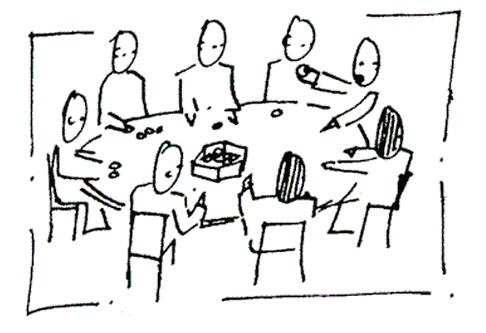
Typically, the seminar rooms we use in my institution are still set out in rows - facing front. Occasionally they are grouped together to facilitate group discussion but in rectangles which leave some students straining to join in a conversation. Scale Up is different in that it has provided us with round tables.
The very shape of the tables mean that students are facing each other and many have their backs to the tutor. This can be frustrating for tutors who still need/want to deliver content but is a real boon for student led learning.
A year ago, I "delivered" a session to first year students on designing a research question. I had a PowerPoint presentation and I spoke to them for about 40 minutes. Although I would have liked some interaction, a short exercise asking them to apply what I had just said to their own projects resulted in very little response.
A year on and I knew that the same style of delivery would be difficult in the Scale Up environment - not just because of seating arrangements, but because by now the students are used to getting on with group work and impatient of long presentations.
So this time I gave them a worksheet on which they were to write their tentative research question. The worksheet also contained a list of criteria by which the research question could be evaluated. The idea was to pass on their own question for another group to evaluate and then reflect on the feedback to help refine the final wording.
As they completed the exercise, I went round the groups challenging them and debating their questions and their feedback to one another. I could have done this exercise in this way a year ago but didn't. Working in this new environment has made me think differently about how I teach.
Is my teaching content different?
There is certainly less content as the focus of the sessions is on students researching on line and finding out for themselves. The other major innovation in the Scale Up classroom is the availability of wifi and laptops. So my teaching now is less about content and more about process, and as the year has progressed and the students have become familiar with the technology and the student directed format, there is in any case less teaching altogether.
Sessions - like today's - can seem rather chaotic on the surface as students are all occupied on different tasks, producing their final projects. This is not so much perceived as chaos by the students - who are (facing away from the front and towards one another) conscious mainly of their own group's interactions - but by the teacher. I flit from group to group helping with technical queries about specific tools and websites or answering questions about the assessment process, witnessing the development of the groups' projects as I pass by.
So the shape of the room, the shape of the tables, shape the interaction between student and teacher and shape the how and the what of the teaching. I feel too that in this environment the students are also shaping how I teach. The room, the wifi, the tables, the access to the internet, give the students a power they didn't have (or couldn't access immediately or maybe legitimately) a year ago. Now I feel that somehow the power balance in the room is shifting as they start to determine the content, pace and process of their learning, relying on me for support the way they rely on Google. My teacher is an app?
So, is this scary? Fun? A bit of both I guess. In one sense I feel I am losing control of the classroom and that what I am witnessing is just poor behaviour management on my part. On the other hand, I am back to my Rogerian Freedom-to-Learn roots as "one who creates the environment for engagement"
Now that is exciting!
Labels:
digital literacy,
futureEd,
Rogers,
ScaleUp,
student engagement,
teaching,
technology
Subscribe to:
Posts (Atom)