Showing posts with label Rogers. Show all posts
Monday, 3 March 2014
#FutureEd How we teach shapes what we teach
In last week's videos Cathy Davidson was discussing how teaching and learning is shaped by the technology we use. This seems very apt in the case of my classroom.
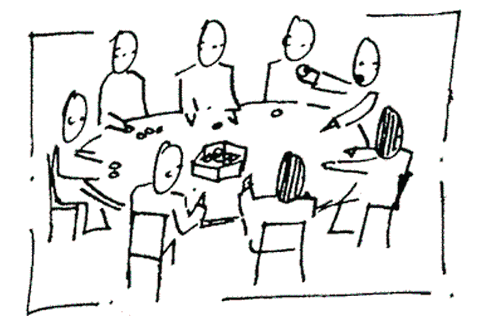
Typically, the seminar rooms we use in my institution are still set out in rows - facing front. Occasionally they are grouped together to facilitate group discussion but in rectangles which leave some students straining to join in a conversation. Scale Up is different in that it has provided us with round tables.
The very shape of the tables mean that students are facing each other and many have their backs to the tutor. This can be frustrating for tutors who still need/want to deliver content but is a real boon for student led learning.
A year ago, I "delivered" a session to first year students on designing a research question. I had a PowerPoint presentation and I spoke to them for about 40 minutes. Although I would have liked some interaction, a short exercise asking them to apply what I had just said to their own projects resulted in very little response.
A year on and I knew that the same style of delivery would be difficult in the Scale Up environment - not just because of seating arrangements, but because by now the students are used to getting on with group work and impatient of long presentations.
So this time I gave them a worksheet on which they were to write their tentative research question. The worksheet also contained a list of criteria by which the research question could be evaluated. The idea was to pass on their own question for another group to evaluate and then reflect on the feedback to help refine the final wording.
As they completed the exercise, I went round the groups challenging them and debating their questions and their feedback to one another. I could have done this exercise in this way a year ago but didn't. Working in this new environment has made me think differently about how I teach.
Is my teaching content different?
There is certainly less content as the focus of the sessions is on students researching on line and finding out for themselves. The other major innovation in the Scale Up classroom is the availability of wifi and laptops. So my teaching now is less about content and more about process, and as the year has progressed and the students have become familiar with the technology and the student directed format, there is in any case less teaching altogether.
Sessions - like today's - can seem rather chaotic on the surface as students are all occupied on different tasks, producing their final projects. This is not so much perceived as chaos by the students - who are (facing away from the front and towards one another) conscious mainly of their own group's interactions - but by the teacher. I flit from group to group helping with technical queries about specific tools and websites or answering questions about the assessment process, witnessing the development of the groups' projects as I pass by.
So the shape of the room, the shape of the tables, shape the interaction between student and teacher and shape the how and the what of the teaching. I feel too that in this environment the students are also shaping how I teach. The room, the wifi, the tables, the access to the internet, give the students a power they didn't have (or couldn't access immediately or maybe legitimately) a year ago. Now I feel that somehow the power balance in the room is shifting as they start to determine the content, pace and process of their learning, relying on me for support the way they rely on Google. My teacher is an app?
So, is this scary? Fun? A bit of both I guess. In one sense I feel I am losing control of the classroom and that what I am witnessing is just poor behaviour management on my part. On the other hand, I am back to my Rogerian Freedom-to-Learn roots as "one who creates the environment for engagement"
Now that is exciting!
Labels:
digital literacy,
futureEd,
Rogers,
ScaleUp,
student engagement,
teaching,
technology
Tuesday, 21 January 2014
#rhizo14 Week 2 Enforced Independence
Well there's an oxymoron if ever I heard one....
.... and yet this is exactly what I am wrestling with in my first year undergraduate module. The students enter University expecting - and sometimes even demanding - very detailed guidance, worksheets, notes and handouts. They think lectures are the way University education should be done - I even had some first year students tell me today that they preferred exams as course work required them to do too much reading and they couldn't handle the distant deadlines: pressure, recall of facts, 2 hours of hand cramps - this is what learning is all about!
So these same students then turn up to my module and they are in a large open space with 100 other students, seated at round tables with Apple Macs available. Or they can bring their own device. Whatever. They get a few minutes of introduction from me for this week's theme and then they get to it - searching the internet, answering questions, posting responses on Twitter, Facebook, Padlet. Whatever. We think about digital identity, digital citizenship, research skills, ethics, intellectual property. I provide a detailed written structure for the module through the VLE where I post links to videos and articles for them to read in their own time. They get feedback through a short formative piece evaluating the role of social media in research; they choose their own work groups for a final summative project using Storify or Pinterest (or... whatever) to curate their online research.
Yup. They hate it.
There's not enough teaching. They don't understand the point of what they are doing. They don't get the relevance of social media to social science research. There are no handouts! (Well, very few). The group is too big and too noisy (these are justifiable complaints in my view!). They can't find anything on the VLE (also possibly justified - its UI is Byzantine). They hate the Macs.
and yet ...... Week 13 of the module: they settle down to the task, they use the Macs with ease, they ask fewer questions. They seem engaged - with the task, with the conversations in their groups. They may just be getting it.
I cut my teeth, teaching wise, in a Person Centred Counselling course. The curriculum was designed by the students (within some constraints). Students peer assessed all the time - in formative practical work and in the final summative dissertation and case study. The group process was in the hands of the group - I was a facilitator. Things got messy - a lot of the time. They hated it. One particularly angry student stated (to the whole group) that the course was rubbish because everything the students learnt they did entirely by themselves. On the final day, after a year of being angry with me about this, she repeated her claim - only now she got it. Yes - they had done it all by themselves. They were/had become independent learners.
The difference with my current students is that they don't really have the same Freedom to Learn. Other parts of their course are taught traditionally. There are exams and course work and grades and structures that will judge the worthiness of the student to progress to another level. There are rules about plagiarism and using Google and Facebook and Twitter and Wikipedia will be frowned upon (maybe even punished). And the biggest oxymoron of all - I am forcing them to be independent. I am not permitting them to learn in the way that is cosy for them, I am imposing (through my power as teacher) a set of conditions and expectations about what is good for them. Just as I do as a parent to my children.
Knowing when to nurture and when to push the chicks out of the nest is key - as is knowing the difference between encouraging independence and abandonment. I don't know how, when or if I ever get this "right" - but then, I am still learning....
Labels:
digital literacy,
learning design,
learning styles,
PBL,
peerassessment,
rhizo14,
Rogers,
technology,
twitter,
VLE,
web2.0
Wednesday, 17 April 2013
#ocTEL Week 1: reflecting on my practice
Well this is timely. In our institution we are just reflecting on module feedback, marking final assignments, planning for the coming year. I am also personally involved in compiling a portfolio for professional recognition.
Reflecting on my practice is something I do as a matter of course through this blog in particular and I think that in itself tends to shape the way I teach, as well as reflect some of my beliefs.
I trained, many years ago, as a person centred counsellor and later took on the role of facilitator in a course that trained other counsellors. It is only recently, reading about various pedagogical approaches and learning theories that I have come to acknowledge that my approach is essentially person centred.
I generally have a great trust in students' ability to think and decide for themselves I talk to them as equals and I expect them to respond with equal respect and honesty. Of course at times I am disappointed - first year students in particular struggle with the transition to University and a student/tutor relationship that may be very different from what they have previously experienced. They seem to either sit quietly expecting to be fed knowledge or switch off from the class and turn on their social networking sites: they don't see themselves as learners so much as hostages trapped in some great anonymous institution.
Getting students to accept responsibility for their own learning is the first, most vital task in year one. So how do we accomplish this?
In my level one module we offer a range of learning activities from sit and listen to the lecture; go away and read something then comment on it in the discussion board; in class paper- or computer-based activities guided by tutor/worksheet; to a final collaborative group project.
On the teaching styles matrix I would say that over the year I move from directed individual towards social autonomous. It can be a painful journey, but having just marked their group projects, I believe it has succeeded.
For collaborative work to be meaningful there has to be some advantage for the students - although these may not be immediately apparent to them. By working collaboratively, weaker students can get to see how other, perhaps stronger, students write and organise themselves. (Learning by proxy). In my view, lurking can be positive. Equally though it is possible to see quieter students coming to the fore when communication is in small groups and especially in virtual communication. (This has been evident in informal student led social networking groups). They also learn how to work together in teams - the hard way.
The other modules I teach are for final year students. From the outset the module is social/autonomous as students form small groups to research and create an online resource. They get very minimal input from me about the technology - they have to go away and pretty much learn this stuff for themselves I provide on line learning materials related to the subject, which are a springboard for further research. I ask that they also maintain a personal blog or reflective journal about the process the group goes through. The final grading for the module is split into a peer assessment of the final online project - including leaving feedback via the discussion board for one another - and a short reflective individual piece, based on their blogs, which I grade.
Carl Rogers' Freedom to Learn is a great read for educators. His basic precepts are:
The greatest buzz I get out of "teaching" is when I am not - that is, when students are discovering for themselves and feel proud of their own achievements. I don't win plaudits from my students about the brilliance of my lectures, but they do say that I am supportive, that I treat them like adults, that they have fun and that they learn stuff without really realizing they are doing so.
I use a lot of tech in my teaching - videos to bring in other voices and views; Facebook and Twitter to connect to the outside world; blogs, wikis, Diigo, Dropbox and Evernote for reflection and information management. At the moment this is all fairly chaotic (my students also notice that and tell me about it!) and I hope to use the ocTEL course to become more systematic in the way I share my love of tech with my students.
Reflecting on my practice is something I do as a matter of course through this blog in particular and I think that in itself tends to shape the way I teach, as well as reflect some of my beliefs.
I trained, many years ago, as a person centred counsellor and later took on the role of facilitator in a course that trained other counsellors. It is only recently, reading about various pedagogical approaches and learning theories that I have come to acknowledge that my approach is essentially person centred.
I generally have a great trust in students' ability to think and decide for themselves I talk to them as equals and I expect them to respond with equal respect and honesty. Of course at times I am disappointed - first year students in particular struggle with the transition to University and a student/tutor relationship that may be very different from what they have previously experienced. They seem to either sit quietly expecting to be fed knowledge or switch off from the class and turn on their social networking sites: they don't see themselves as learners so much as hostages trapped in some great anonymous institution.
Getting students to accept responsibility for their own learning is the first, most vital task in year one. So how do we accomplish this?
In my level one module we offer a range of learning activities from sit and listen to the lecture; go away and read something then comment on it in the discussion board; in class paper- or computer-based activities guided by tutor/worksheet; to a final collaborative group project.
On the teaching styles matrix I would say that over the year I move from directed individual towards social autonomous. It can be a painful journey, but having just marked their group projects, I believe it has succeeded.
For collaborative work to be meaningful there has to be some advantage for the students - although these may not be immediately apparent to them. By working collaboratively, weaker students can get to see how other, perhaps stronger, students write and organise themselves. (Learning by proxy). In my view, lurking can be positive. Equally though it is possible to see quieter students coming to the fore when communication is in small groups and especially in virtual communication. (This has been evident in informal student led social networking groups). They also learn how to work together in teams - the hard way.
The other modules I teach are for final year students. From the outset the module is social/autonomous as students form small groups to research and create an online resource. They get very minimal input from me about the technology - they have to go away and pretty much learn this stuff for themselves I provide on line learning materials related to the subject, which are a springboard for further research. I ask that they also maintain a personal blog or reflective journal about the process the group goes through. The final grading for the module is split into a peer assessment of the final online project - including leaving feedback via the discussion board for one another - and a short reflective individual piece, based on their blogs, which I grade.
Carl Rogers' Freedom to Learn is a great read for educators. His basic precepts are:
We cannot teach another person directly; we can only facilitate his learning.The structure and organization of the self appears to become more rigid under threat; to relax its boundaries when completely free from threat...
The educational situation which most effectively promotes significant learning is one in which 1) threat to the self of the learner is reduced a minimum, and 2) differentiated perception of the field of experience is facilitated.
The greatest buzz I get out of "teaching" is when I am not - that is, when students are discovering for themselves and feel proud of their own achievements. I don't win plaudits from my students about the brilliance of my lectures, but they do say that I am supportive, that I treat them like adults, that they have fun and that they learn stuff without really realizing they are doing so.
I use a lot of tech in my teaching - videos to bring in other voices and views; Facebook and Twitter to connect to the outside world; blogs, wikis, Diigo, Dropbox and Evernote for reflection and information management. At the moment this is all fairly chaotic (my students also notice that and tell me about it!) and I hope to use the ocTEL course to become more systematic in the way I share my love of tech with my students.
Labels:
#ocTEL,
blog,
collaboration,
diigo,
learning design,
Rogers,
teaching
Subscribe to:
Posts (Atom)


