Showing posts with label teaching. Show all posts

Friday, 6 June 2014

Trust

https://www.flickr.com/photos/marilynjane/5877663279 
Some thinking I have been doing in advance of the APT conference in July "Connected Learning in an Open World".......


What makes a classroom connected and open and how do these factors change the behaviours of both teacher AND student?

For me openness has many facets. It's about being open to change, open to student centred strategies, open to students taking over the content and design, going beyond the closed environment of the traditional classroom to encompass the wider world and even encroaching on the students' and the teachers' private space and time.

Connected can mean a classroom that is connected to the internet, but also means students being connected to one another - working together to solve a problem, both in the classroom and beyond it. Connected too to the teacher in new ways - through social networks as well as email or face to face in classroom time and tutorials.

Once you start to change the teaching environment you change the way learning happens. Until very recently the traditional classroom had not changed its appearance in over a century and our traditional expectations of student behaviours match this environment - students who are attentive, facing forward, sitting in rows and following instructions. Teachers who are standing, speaking and directing. In the connected and open classroom, these boundaries, like the boundaries between classroom time and personal time, teaching space and social space, start to be eroded.

Clearly things are changing and the typical classroom is being disrupted technology. This is a visualisation submitted by a masters student at the University of the Balearic Islands in Ibiza on the impact of ITC in the classroom. This is a great video, exemplifying the notion of connectedness and openness on so many levels: the student uses You Tube to submit his assignment and he adopts a meme - the Harlem Shake - which itself symbolises both collaboration and disruption.


So yes, we think of BOYD, wifi,  technology in the classroom, the internet, flipped approaches etc, as being the disruptive elements that bring about connectedness and openness, but there's something else that makes a difference - and again we saw it in the video: seating arrangements.

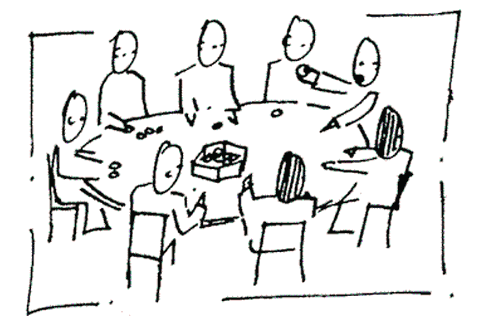
In the US there has been developing a movement? known as Scale Up which is changing the shape of classrooms. There are some variations but essentially the space is dominated by large round tables seating 9 students in 3 groups of 3. Round tables are especially important because they enable the student to look at other students and not at the teacher, symbolising a less teacher dependent and more collaborative way of working.

This has an impact on how we structure teaching sessions: to make full use of this new type of space, it is necessary to rethink the curriculum and the pedagogy. As an example - when I first started to teach this module it was known as Study Skills. Students completed their main assignment by visiting the library and finding and photocopying three journal articles about a particular group of users of health or social care services, they wrote a short precis of the three articles and submitted an individual hard copy (this is just 4 years ago). Now the module is known as Research and Professional Practice: students work collaboratively in groups to research a particular group of users of services, but this time using electornic databases, websites and social media as their sources. They submit their final projects using an internet based platform such as Pinterest or Tumblr. The curriculum focus on digital citizenship and skills and instead of lectures and seminars, there are active workshops where over 100 students come together to learn, work and create.

I'd love to be able to tell you that this module is a big success and that all the students are over the moon about the new classroom . They are not. They sometimes find it hard to see the relevance of what they are doing to a career in health and social care. They find the classroom noisy and unfocussed. They find the tasks too demanding - or not demanding enough. Attendance has not improved. Grades have not improved. The workshops and the planning that goes in to them are exhausting for the teaching staff too. But we are doing something difficult here, running just one module in this way - sowing the seeds of change - in a first year that is delivered 80% traditionally - 1 lecture/1 seminar. I like what Dewey said about the familiar....
Familiarity breeds contempt, but it also breeds something like affection. We get used to the chains we wear, and we miss them when removed. ~ John Dewey, The Child and the Curriculum (1902)
First year students in particular like and expect the traditional lecture and seminar format - they feel this is where and how they actually learn something. Freeing them from their familiar chains is going to take time.

SCALE UP stands for Student Centred Active Learning Environment with Upside down Pedagogies - essentially the flipped classroom approach is used with students studying learning materials at home and coming to class to participate in activities which demonstrate the theory.

In Scale UP US style - which actually originally focussed on Undergraduate Physics - students are tested, ranked and then assigned to mixed ability groups for the activities and group assignments. Each student in the three-member group also has a secific role - which alternates each week. These are generally the recorder or note taker, the investigator/experimenter and the sceptic or questioner who challenges the group's assumptions.

My institution in the past 12 months have adopted the Scale Up methodoloy and I volunteered to be one of the "early adopters" for my first year module in Study Skills.

My own classroom looks superficially like the MIT set up, but with considerably less space, which does cause some problems of noise and restricted movement. I also don't test students and place them in mixed ability groups. However, my students are provided with Mac Books. This is also a feature of more recent iterations of Scale Up, the group of three students share one lap top so that the emphasis is on shared learning and collaboration.

This contrasts with the way I used to teach the "techie" bits of my module - that is, as distinct topics, in one off sessions in a computer lab, where each student had their own pc and where their focus was still predominantly on following what the teacher was doing.

So in the Scale Up classroom, round tables are helping to provide more connectedness. Another important aspect is the wifi - which in this classroom is generally reliable and fast. This allows the students to turn their faces even further away from the teacher, and makes the classroom walls even more permeable or open to the outside world.

In my module I see this having an impact on two levels: firstly by enhancing the independent learning of the students - i.e by encouraging them to find their own answers ("Google It!!"). Secondly by supporting them to develop "digital competencies" - using effective search strategies, evaluating what they find on line, bookmarking and storing information safely, presenting information in innovative ways, using social media appropriately and developing an online identity that is congruent with their future roles as health and social care professionals.

Having a connected and open classroom has changed the form of the assessment. Last year it was classroom tests and essays about the value of social media in education. This year its a presentation of their research using social media - both as the source of information and as a presentation platform (e.g a Pinterest board about homelessness; a Tumblr blog about fostering and adoption).

So now, a funny story that almost completely undermines everything I have been saying about classroom design. In April I went to the University of Murcia on an Erasmus exchange to witness for myself some really advanced work in the use of TEL. My hosts in the Faculty of Education have an international reputation in this field.

Due to some losses in translation, I was expecting an open and connected classroom not unlike my own. I had been asked to conduct an interactive workshop on using social media for research (Pinterest) for a group of teachers in training on a module which focuses on the use of ITC in the classroom. What I found was a traditional raked lecture theatre, students who brought in a variety of devices of their own and, on that particular day - no wifi. After an initial panic, the students simply downloaded the phone app and did the exercise that way, sharing information with one another until each group was able to get on line and start on their pinboards. The teachers didn't intervene or help in any way (to be honest I had forgotten 3G and phone apps in my panic and dismay at everything going wrong). This is part of the ethos in the team that runs this programme. They told me that they used to give quite a lot of instruction to students about platforms and tools they could use; now that support is minimal. The students complain and get distressed that they can't manage these new ways of working without teacher input, but gradually they go away and get on with it. And they are proud of their achievements.

At the end of the day this is not really about technology, it is about decreasing students' dependence on the teacher as the fount of all wisdom and coming to view themselves as thinkers, creators and teachers.

So, the moral of the story is that what really makes for a great pedagogy in the open and connected classroom is not the technology, not the tables, not the wifi, not even the flipped classroom. What is most important here is TRUST - of the teacher in the student and of the student in himself.

As I reflect on my experiences home and abroad over the last year, and look forward to the reshaping of the curriculum for the next one, it is this notion of trust that I am going to try and embed into my plans. Trust isn't the same as blind faith. I know things will go wrong, but I also know that there will be something to learn. So I guess I'm going to have to trust myself on that too.




Sunday, 13 April 2014

Erasmus reflections: the view from home

The old campus of  Universidad de Murcia
So - now I'm home, the bags are unpacked and I have filled in my official report for the Erasmus scheme.

It is important now to reflect on what has been the value of the exchange and what do I think will change as a result of it?

Firstly for me, the immersion in a new environment, a different culture and with the opportunity to speak and listen daily in the language I am studying has been invaluable. This is a tiring process but the rapid development of fluency and vocabulary is amazing - and it is something that just doesn't happen in a normal holiday experience, especially if you go with another English speaker, as you simply don't need to speak as much when you are pretty much a self contained unit. Travelling alone brings different challenges and working rather than just being a tourist requires a more sophisticated vocabulary altogether.

In terms of personal learning about education, this has many levels. I saw at first hand the impact of democratic processes in the appointment of senior managers - something which doesn't happen in my university. It is interesting to compare the different educational systems (UK and Spain) - the growth of private universities for example. And student experiences differ, with many young people often choosing to continue living at home whilst studying.

I was very careful in my choice of university to visit. I had a specific interest in technology enhanced learning and the University of Murcia is fortunate in having a reknowned Innovation Unit and reknowned innovation leaders in Mari Paz Prendes Espinosa and Linda Casteñada. In particular being able to work with Linda and Maria Mar Sánchez in their classrooms taught me a huge amount about trusting the students to find their way with technology and about the value of setting creative challenges.

Delivering a workshop for the bilingual student teachers was a personal challenge. My delivery and design was not really very much different from what I would have done for my own class, but the room set up and available technology presented another sort of challenge - and performing in front of an unfamilar audience (and such a great teacher as Linda) did make me a little nervous. But I can at least now add international teaching to my CV!

The links forged with the University of Murcia have the potential to be of great mutual benefit. I hope on a personal level to continue having contact with the Innovation team in order to collaborate on projects - and to undertake a language exchange with Marimar Roman with regular Skype calls or Hangouts.

I am also hopeful that there could be student and other staff exchanges in the Social Work discipline as a result of contacts I made there - and with luck I'll be going back!


Sunday, 9 March 2014

make a change.... #FutureEd


And so the MOOC about the History and future of Higher Education has come to an end. I have actually completed all the assignments, watched all the video lectures and read at least the core text - Now You See It - which was provided free of charge.

This has been a really stimulating course which, more than other MOOC I have dipped into, fully held my attention and taught me useful things that have impacted my thinking about my teaching practice.

Each week the topics of the videos - and the reading alongside - have caused me to stop and think about what I do and why I do it and further, have made me want to change what I do. Actually, to be more  specific the MOOC has given me the confidence to put into practice changes I have wanted to make but didn't feel I could. In particular - thinking about ways in which I could support students to build their own curriculum. This is what I think it means to make alliances with other change makers. If you are the only person who dreams of something different you may feel you don't have the strength to do it.

I have also been struck by the notion of proximity - and this has made me stop and look a little more closely at some of the great things that are going on in my own team - so I have come to see that we are most of us really trying to do something a little different, but perhaps not feeling fully confident to do it on a big scale just in case it doesn't work.

If you put these two ideas together - you get small communities of practice at the local level who have a dream to change things and can support one another to do just that.

Unfortunately there is always another side to the story. In sharing and in trying to do something different we leave ourselves exposed to criticism of the most unconstructive kind. I was really sad to note, in the closing forums of the MOOC,some really harsh comments about the leader, Cathy Davidson, as well as of Coursera and the very idea of a MOOC. Whilst I can understand and even sympathise with criticisms about the assessment process and the relevance of some of the activities, wanton "trolling" of someone who seems genuinely enthusiastic about sharing her expertise and experience for free seems rather churlish. Similarly, I know I come in for a lot of criticism for trying to do things differently in my teaching  - although less through open trolling (no conveniently shielding internet forum), more through the unsolicited offer of "feedback" that colleagues have "heard" from unhappy students and feel I ought to be "made aware of". The irony is that I would genuinely like feedback from colleagues interested enough to come and actually observe my classes - or even who want to talk to me about my objectives in doing what I do.

But despite these disappointments,  I have been inspired to share my practice more widely and to try to learn from those further afield. During this MOOC I have submitted two small presentation ideas for international conferences.

My aim is to go and meet people from different kinds of educational institutions in different countries both to talk about what I do and also to listen to them talk about what they do. One of the conferences was actually inviting presentations outlining a classroom project that maybe hadn't gone exactly as planned but which was providing some learning and new ideas for the future. How nice to be able to go and talk openly about "unlearning" - and learning from mistakes - rather than having to present the usual facade of expertise, knowing and perfect practice.

I will be making changes in my own classes as a result of this MOOC and as a result of just listening better to my students - and my colleagues. There is also a part of me now wanting to be part of making changes on a much wider scale, but of course as Lao Tzu said - a journey of a thousand miles begins right where you stand.


Monday, 3 March 2014

#FutureEd How we teach shapes what we teach


In last week's videos Cathy Davidson was discussing how teaching and learning is shaped by the technology we use. This seems very apt in the case of my classroom.

Typically, the seminar rooms we use in my institution are still set out in rows - facing front. Occasionally they are grouped together to facilitate group discussion but in rectangles which leave some students straining to join in a conversation. Scale Up is different in that it has provided us with round tables.

The very shape of the tables mean that students are facing each other and many have their backs to the tutor. This can be frustrating for tutors who still need/want to deliver content but is a real boon for student led learning.

A year ago, I "delivered" a session to first year students on designing a research question. I had a PowerPoint presentation and I spoke to them for about 40 minutes. Although I would have liked some interaction, a short exercise asking them to apply what I had just said to their own projects resulted in very little response.

A year on and I knew that the same style of delivery would be difficult in the Scale Up environment - not just because of seating arrangements, but because by now the students are used to getting on with group work and impatient of long presentations.

So this time I gave them a worksheet on which they were to write their tentative research question. The worksheet also contained a list of criteria by which the research question could be evaluated. The idea was to pass on their own question for another group to evaluate and then reflect on the feedback to help refine the final wording.

As they completed the exercise, I went round the groups challenging them and debating their questions and their feedback to one another. I could have done this exercise in this way a year ago but didn't. Working in this new environment has made me think differently about how I teach.

Is my teaching content different?
There is certainly less content as the focus of the sessions is on students researching on line and finding out for themselves. The other major innovation in the Scale Up classroom is the availability of wifi and laptops. So my teaching now is less about content and more about process, and as the year has progressed and the students have become familiar with the technology and the student directed format, there is in any case less teaching altogether.

Sessions  - like today's - can seem rather chaotic on the surface as students are all occupied on different tasks, producing their final projects. This is not so much perceived as chaos by the students - who are (facing away from the front and towards one another) conscious mainly of their own group's interactions - but by the teacher. I flit from group to group helping with technical queries about specific tools and websites or answering questions about the assessment process, witnessing the development of the groups' projects as I pass by.

So the shape of the room, the shape of the tables, shape the interaction between student and teacher and shape the how and the what of the teaching. I feel too that in this environment the students are also shaping how I teach. The room, the wifi, the tables, the access to the internet, give the students a power they didn't have (or couldn't access immediately or maybe legitimately) a year ago. Now I feel that somehow the power balance in the room is shifting as they start to determine the content, pace and process of their learning, relying on me for support the way they rely on Google. My teacher is an app?

So, is this scary? Fun?  A bit of both I guess. In one sense I feel I am losing control of the classroom and that what I am witnessing is just poor behaviour management on my part. On the other hand, I am back to my Rogerian Freedom-to-Learn roots as "one who creates the environment for engagement"

Now that is exciting!

Thursday, 30 January 2014

The joy of salsa! #FutureEd


This is my first assignment for the MOOC #FutureEd https://class.coursera.org/highered-001/ The task is to write about something you have had to unlearn in order to learn something new. As I wrote this - initially feeling a little uncertain about the "political correctness" of writing about being the submissive female follower in a rather macho dance form - I began to see this as a metaphor for learning on a bigger scale. 

When I first went to a salsa class, I had always considered myself to be a good dancer - but I had never danced with a partner. I didn't have too much trouble learning the basic steps and picking up the rhythm - in fact that part was really fun. The unlearning came when I had to dance with a man! I really did not know how to let go of my need to be in control and let him lead. In fact, it felt unfair that the man ALWAYS led and decided on the choreography as the dance unfolded.

Frankly this made me a very poor dance partner. My arms were stiff from resisting the lead, I moved ahead of the music, anticipating the next steps - or my feet seemed to refuse to do as they were "told" and became leaden and unresponsive. Practice with my partner became a time of tears and tantrums and I constantly felt angry and ashamed of my lack of progress.

Gradually I came to feel how impossible it was to have two leads in the dance. I also began to understand that to follow was an art form in itself. To be able to interpret the subtleties of the lead, to feel the flow of the dance, required its own skill. I also saw that as the follower, my steps were often more complicated, involving lots of spinning, and it was impossible for me to concentrate on the choreography or direction of the dance on my own - I needed my partner to take care of those things, to support me and allow me to shine!

There are still times when I feel frustrated as a dancer that I am not "permitted" to take over (although I have now learnt how to lead!) but I also know that there is great satisfaction to be had from knowing how to work in partnership.

Two years ago I travelled from the UK to an educational conference in San Diego and whilst there visited a wonderful salsa club. It was a magical experience for me - dancing the night away with a succession of charming young men, feeling a great sense of mastery in my ability to "follow", and co-creating with them dances that were as lovely as they were surprising.


By unlearning my habit of controlling I discovered the international community of salsa and the joy of dancing. 

I guess the moral of this story (and I am just realising this as I write) is that letting go of control and being prepared to step into the unknown is an essential part of participating in a learning community, whether as teacher or student. When I wear the hat of teacher, I still hold on to the illusion of control and yet every new group of students, every start of each new academic year is a step into the unknown – a new dance, in which I am once again aiming to be the skilled follower.

Sunday, 10 November 2013

A pedagogy for the millenials? #digilit

This week, in the course of some Twitter-based research for my next leadership workshop,  I came across this nice little video about leadership and motivation as it relates to the Millenial generation.

For me it had resonance with teaching and learning in this new age. True I have many students who are Gen X or even Baby Boomers. True, not all Millenial babies are genuinely digitally native in their behaviours, but it is important I think to recognise that we (Baby Boomer staff) are dealing with a new generation and need a pedagogy (or maybe more appropriately an androgogy) that suits the times.

Androgogy is perhaps the term we should apply to adult learners in HE - certainly we anticipate the sort of transitions indicated in Knowles' (1984) definition as students progress through a University education:

1. Self-concept: As a person matures his self concept moves from one of being a dependent personality toward one of being a self-directed human being
2. Experience: As a person matures he accumulates a growing reservoir of experience that becomes an increasing resource for learning.
3. Readiness to learn. As a person matures his readiness to learn becomes oriented increasingly to the developmental tasks of his social roles.
4. Orientation to learning. As a person matures his time perspective changes from one of postponed application of knowledge to immediacy of application, and accordingly his orientation toward learning shifts from one of subject-centeredness to one of problem centredness.
5. Motivation to learn: As a person matures the motivation to learn is internal(Knowles 1984:12). (from Infed)

but I wonder how much our attitudes towards teaching and learning get in the way of aiding this transition? The chart above (from: http://www.educatorstechnology.com/2013/05/awesome-chart-on-pedagogy-vs-andragogy.html) illustrates some of the key differences between androgogical and pedagogical approaches.

In a conversation with students earlier this week as part of the Changing the Learning Landscape project we heard of practices in classrooms that still assume a much more passive role on the part of learners, with the "lecturer" still expert and dominating the classroom activity as they did in the Victorian schoolroom.

Trying as I do to teach with technology, to support the development of digital skills and the responsible use of the Internet for research, I can't see how I can achieve my aims without harnessing the students' native abilities and attitudes - making space for them to learn collaboratively, allowing noise - allowing mobile devices - in the classroom, building on their well developed social networking skills to show how these can be used to support research and learning. I was trying to explain how my workshops go to colleagues this week and their response was "yes, but where's the academic rigour, where's the voice of the expert? This might work in something like study skills but would it work in, say, a history degree?"  I wonder why it wouldn't?

A problem based, technology enhanced, collaborative approach makes for a messy and complicated classroom verging on the chaotic at times. It's not always comfortable for me or the learners but I am starting to see some "green shoots" of independent learning and great engagement in the classroom and interestingly it is some of the older "non-traditional" students who seem to be enjoying and benefiting from this approach. Whilst the Millenials may be feeling more  "so what?" about my classes, the older students have been feeding back to me their excitement about their developing digital competence. One student wrote to me this week that my module was "possibly the most interesting and also the most complicated" of all those he was studying. In my book, that's not a bad thing :)


Wednesday, 17 April 2013

#ocTEL Week 1: reflecting on my practice

Well this is timely. In our institution we are just reflecting on module feedback, marking final assignments, planning for the coming year. I am also personally involved in compiling a portfolio for professional recognition.

Reflecting on my practice is something I do as a matter of course through this blog in particular and I think that in itself tends to shape the way I teach, as well as reflect some of my beliefs.

I trained, many years ago, as a person centred counsellor and later took on the role of facilitator in a course that trained other counsellors. It is only recently, reading about various pedagogical approaches and learning theories that I have come to acknowledge that my approach is essentially person centred.

I generally have a great trust in students' ability to think and decide for themselves  I talk to them as equals and I expect them to respond with equal respect and honesty. Of course at times I am disappointed - first year students in particular struggle with the transition to University and a student/tutor relationship  that may be very different from what they have previously experienced. They seem to either sit quietly expecting to be fed knowledge or switch off from the class and turn on their social networking sites: they don't see themselves as learners so much as hostages trapped in some great anonymous institution.

Getting students to accept responsibility for their own learning is the first, most vital task in year one. So how do we accomplish this?

In my level one module we offer a range of learning activities from sit and listen to the lecture; go away and read something then comment on it in the discussion board; in class paper- or computer-based activities guided by tutor/worksheet;  to a final collaborative group project.

On the teaching styles matrix I would say that over the year I move from directed individual towards social autonomous. It can be a painful journey, but having just marked their group projects, I believe it has succeeded.

For collaborative work to be meaningful there has to be some advantage for the students - although these may not be immediately apparent to them. By working collaboratively, weaker students can get to see how other, perhaps stronger, students write and organise themselves. (Learning by proxy). In my view, lurking can be positive. Equally though it is possible to see quieter students coming to the fore when communication is in small groups and especially in virtual communication. (This has been evident in informal student led social networking groups). They also learn how to work together in teams - the hard way.

The other modules I teach are for final year students. From the outset the module is social/autonomous as students form small groups to research and create an online resource. They get very minimal input from me about the technology - they have to go away and pretty much learn this stuff for themselves  I provide on line learning materials related to the subject, which are a springboard for further research. I ask that they also maintain a personal blog or reflective journal about the process the group goes through. The final grading for the module is split into a peer assessment of the final online project - including leaving feedback via the discussion board for one another - and a short reflective individual piece, based on their blogs, which I grade.

Carl Rogers'  Freedom to Learn is a great read for educators. His basic precepts are:
We cannot teach another person directly; we can only facilitate his learning.The structure and organization of the self appears to become more rigid under threat; to relax its boundaries when completely free from threat...
The educational situation which most effectively promotes significant learning is one in which 1) threat to the self of the learner is reduced a minimum, and 2) differentiated perception of the field of experience is facilitated.


The greatest buzz I get out of "teaching" is when I am not - that is, when students are discovering for themselves and feel proud of their own achievements. I don't win plaudits from my students about the brilliance of my lectures, but they do say that I am supportive, that I treat them like adults, that they have fun and that they learn stuff without really realizing they are doing so.

I use a lot of tech  in my teaching - videos to bring in other voices and views; Facebook and Twitter to connect to the outside world; blogs, wikis, Diigo, Dropbox and Evernote for reflection and information management. At the moment this is all fairly chaotic (my students also notice that and tell me about it!) and I hope to use the ocTEL course to become more systematic in the way I share my love of tech with my students.

Saturday, 19 January 2013

#oldsmooc #digilit the skies are clearing

image: jane challinor (Sky over the Trent)

Decided to organise myself a bit and put links to those clouds (or pages) that I NEED altogether on my learning journal page - creating my own PLE within the MOOC!

Some interesting ideas for developing a design through exploring context, using scenarios and personas. Today onto mapping tools. I think this is a useful way to articulate what I have had in my head for a few years now and should hopefully help me to design something that could work instead of my usual "suck it and see" method.

Having a buddy really helps. Helen C developed a scenario for a mature student and I did one for a "traditional one". Despite never having met or even really discussed my course, her scenario was uncannily accurate. The mature student she described is definitely one I recognise from my current cohort!

Some other thoughts about context - the staff side of things. Within the course team I think I am one of only three members of staff who have a FB account. Two of us are on Twitter. None of these uses these sm platforms for anything other than social contact. One other besides me uses wikis with her students but confesses to never having used a wiki herself. None do social bookmarking or have what could be described as a (virtual) PLN.

Use of the VLE varies and the quality of design of those learning rooms which are well used  is highly inconsistent. The preferred way of organising teaching and learning is:

Lecture - notes/PPT on the VLE - seminar group discussion - individual assignment handed into school office - feedback sheet with grade and brief comments. Occasionally, group work involving Power point or an A3 poster. Rarely, VLE Discussion Board activity which is mainly student to teacher oriented with little student to student interaction.

Having discussions in the team about e-submission of assignments causes anxiety; mention of Twitter,FB or wikis for learning evokes a) terror b) moral panic c) derision d) awe

I think therefore that I need to add some new personas into my scenario because I need to recognise that without wider acceptance within the team of the need for digital information literacy, this module is not going to change things at the rate and to the extent needed to be really effective.

Working in favour of change is the team's recognition that research skills among our students are poor and levels of independent learning low. Poor academic practice is also rife and student engagement could definitely be better.

Ultimately, my dream is that a  well designed digital information literacy module should  provide support for the course as a whole.

Sunday, 27 November 2011

We don't need no educator?

The many roles performed by educators today: (via +Sue Beckingham on Google+)