Thursday, 20 March 2014

Learning from my students - and a Twitter tale....


I am reviewing students' final reflective assignments at the moment (on the theme of team work) and I noticed a number of them referring to a specific model (http://www.team-diagnostics.com/the-model.php) which I had not seen before.

It is a really interesting model developed by Hackman and building on his earlier work on Team Effectiveness, which I do refer to in my module.

I assumed students had found this by googling the name Hackman, but I later realised that I had myself re-Tweeted a link to the model (without actually reading the article - as a "save for later" read) and simultaneously posted it on my LinkedIn feed.

I now realise that those students who used it are the same ones who follow me on Twitter and Linked In.

On a related note: as I have been marking, I have had a slight sense of irritation that so few of the resources I carefully curate at the start of the module ever actually end up in the students' reference lists - preferring as they do to google and use whatever popular business style websites pop up on top.

However, there are also some instances where they have managed to find articles that really add depth to the discussion and which I have found develop my understanding of the subject.

This lends weight to a) my intention next year to include NO RESOURCES WHATSOEVER on the module and let them research their own

and b) my belief that Twitter can be a useful tool to share this research in and around the module

In fact a completely Tweeted module sounds good to me!

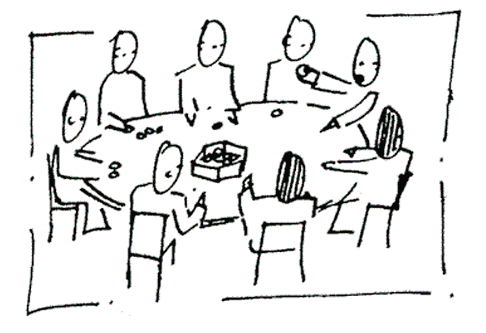
(p.s this was my first attempt at embedding a free image from Getty images - now freely available for non commercial embedding: give it a go!)


Sunday, 9 March 2014

make a change.... #FutureEd


And so the MOOC about the History and future of Higher Education has come to an end. I have actually completed all the assignments, watched all the video lectures and read at least the core text - Now You See It - which was provided free of charge.

This has been a really stimulating course which, more than other MOOC I have dipped into, fully held my attention and taught me useful things that have impacted my thinking about my teaching practice.

Each week the topics of the videos - and the reading alongside - have caused me to stop and think about what I do and why I do it and further, have made me want to change what I do. Actually, to be more  specific the MOOC has given me the confidence to put into practice changes I have wanted to make but didn't feel I could. In particular - thinking about ways in which I could support students to build their own curriculum. This is what I think it means to make alliances with other change makers. If you are the only person who dreams of something different you may feel you don't have the strength to do it.

I have also been struck by the notion of proximity - and this has made me stop and look a little more closely at some of the great things that are going on in my own team - so I have come to see that we are most of us really trying to do something a little different, but perhaps not feeling fully confident to do it on a big scale just in case it doesn't work.

If you put these two ideas together - you get small communities of practice at the local level who have a dream to change things and can support one another to do just that.

Unfortunately there is always another side to the story. In sharing and in trying to do something different we leave ourselves exposed to criticism of the most unconstructive kind. I was really sad to note, in the closing forums of the MOOC,some really harsh comments about the leader, Cathy Davidson, as well as of Coursera and the very idea of a MOOC. Whilst I can understand and even sympathise with criticisms about the assessment process and the relevance of some of the activities, wanton "trolling" of someone who seems genuinely enthusiastic about sharing her expertise and experience for free seems rather churlish. Similarly, I know I come in for a lot of criticism for trying to do things differently in my teaching  - although less through open trolling (no conveniently shielding internet forum), more through the unsolicited offer of "feedback" that colleagues have "heard" from unhappy students and feel I ought to be "made aware of". The irony is that I would genuinely like feedback from colleagues interested enough to come and actually observe my classes - or even who want to talk to me about my objectives in doing what I do.

But despite these disappointments,  I have been inspired to share my practice more widely and to try to learn from those further afield. During this MOOC I have submitted two small presentation ideas for international conferences.

My aim is to go and meet people from different kinds of educational institutions in different countries both to talk about what I do and also to listen to them talk about what they do. One of the conferences was actually inviting presentations outlining a classroom project that maybe hadn't gone exactly as planned but which was providing some learning and new ideas for the future. How nice to be able to go and talk openly about "unlearning" - and learning from mistakes - rather than having to present the usual facade of expertise, knowing and perfect practice.

I will be making changes in my own classes as a result of this MOOC and as a result of just listening better to my students - and my colleagues. There is also a part of me now wanting to be part of making changes on a much wider scale, but of course as Lao Tzu said - a journey of a thousand miles begins right where you stand.


Monday, 3 March 2014

#FutureEd How we teach shapes what we teach


In last week's videos Cathy Davidson was discussing how teaching and learning is shaped by the technology we use. This seems very apt in the case of my classroom.

Typically, the seminar rooms we use in my institution are still set out in rows - facing front. Occasionally they are grouped together to facilitate group discussion but in rectangles which leave some students straining to join in a conversation. Scale Up is different in that it has provided us with round tables.

The very shape of the tables mean that students are facing each other and many have their backs to the tutor. This can be frustrating for tutors who still need/want to deliver content but is a real boon for student led learning.

A year ago, I "delivered" a session to first year students on designing a research question. I had a PowerPoint presentation and I spoke to them for about 40 minutes. Although I would have liked some interaction, a short exercise asking them to apply what I had just said to their own projects resulted in very little response.

A year on and I knew that the same style of delivery would be difficult in the Scale Up environment - not just because of seating arrangements, but because by now the students are used to getting on with group work and impatient of long presentations.

So this time I gave them a worksheet on which they were to write their tentative research question. The worksheet also contained a list of criteria by which the research question could be evaluated. The idea was to pass on their own question for another group to evaluate and then reflect on the feedback to help refine the final wording.

As they completed the exercise, I went round the groups challenging them and debating their questions and their feedback to one another. I could have done this exercise in this way a year ago but didn't. Working in this new environment has made me think differently about how I teach.

Is my teaching content different?
There is certainly less content as the focus of the sessions is on students researching on line and finding out for themselves. The other major innovation in the Scale Up classroom is the availability of wifi and laptops. So my teaching now is less about content and more about process, and as the year has progressed and the students have become familiar with the technology and the student directed format, there is in any case less teaching altogether.

Sessions  - like today's - can seem rather chaotic on the surface as students are all occupied on different tasks, producing their final projects. This is not so much perceived as chaos by the students - who are (facing away from the front and towards one another) conscious mainly of their own group's interactions - but by the teacher. I flit from group to group helping with technical queries about specific tools and websites or answering questions about the assessment process, witnessing the development of the groups' projects as I pass by.

So the shape of the room, the shape of the tables, shape the interaction between student and teacher and shape the how and the what of the teaching. I feel too that in this environment the students are also shaping how I teach. The room, the wifi, the tables, the access to the internet, give the students a power they didn't have (or couldn't access immediately or maybe legitimately) a year ago. Now I feel that somehow the power balance in the room is shifting as they start to determine the content, pace and process of their learning, relying on me for support the way they rely on Google. My teacher is an app?

So, is this scary? Fun?  A bit of both I guess. In one sense I feel I am losing control of the classroom and that what I am witnessing is just poor behaviour management on my part. On the other hand, I am back to my Rogerian Freedom-to-Learn roots as "one who creates the environment for engagement"

Now that is exciting!

Tuesday, 18 February 2014

#FutureEd Learning from my students


OK -this isn't empirical research and it isn't statistically significant, but I had an encounter today with four students which stopped me in my tracks and caused me to rethink my approach to rethinking assessment.

Assessment is a big theme at the moment  - it was the focus of the FutureEd mooc last week, its a matter of debate on the course I teach on, it's also the theme of an assignment my daughter is writing for her PGCE.

I have been really interested in Cathy Davidson's discussion of assessment in her book Now You See It and that in itself has been causing me to rethink a module I teach and how the assessment can be made more pertinent to real skills needed in the workplace and in life.

At the same time I had a worry that assessment methods were becoming a little unbalanced in our first year of the course with quite a strong leaning towards group work at the expense of individual assignments.

Group work is notoriously difficult to assess and often unpopular with students who may feel they are a) doing more than their fair share of work to make up for the loafers and b) missing out on good grades because of poor quality input from others.

Concerns about the quality of students' writing and referencing in years 2 and 3 also caused me to think about introducing more individual, essay-type assessment in the first year in order to try and improve these skills.

But the group that came to see me today, to discuss a first year group assignment I have set, really sold me the idea of group work - particularly for first year students. These four students have worked together in every module requiring a group project and have got to know one another well. One of their number had not studied the subject in college so she was benefiting from the knowledge of the others in getting to grips with the course. Another had come from a completely different education system in a different country so he was also learning from his fellow students - on the other hand, he had years of practical experience working in mental health so he was contributing that. A third student had recently completed an access to HE course so was confident with referencing and research skills and was teaching her friends!

All in all it's a combination that works beautifully and through their working together they have become friends, feel really engaged with the course and have grown in confidence. I realise that other students may be having different - less positive - experiences but if group work can help students engage and learn together, and if they can reap such enhanced benefits from working together across more than one module,  this assessment strategy may actually be the best one we have come up with yet!


Thursday, 6 February 2014

Un-learning pt 2 - #FutureEd #digilit


We are coming to the end of the main phase of my Leading Teams module. The group projects have been completed, the peer feedback uploaded, the self and tutor assement is done and I am just about to release the groups' grades.

The group projects are presented using an online tool - such as Blogger, Wordpress, Wix - and the groups have  a free choice of leader to focus on. Usually a film is selected and its main characters analysed against the main leadership theories and models. This year we had 3 Coach Carters (I banned Toy Story on the grounds that it had been done to death in previous years, I may have to subject Samuel Jackson to the same cruel fate). The Iron Lady and Twelve Angry Men cropped up again but new choices included Mean Girls, Robin Hood, Remember the Titans and The Shawshank Redemption. One group chose to focus on Lord Alan Sugar.

Each presentation is completely different from every other - colourful, interactive, full of images and even humour. Working in groups seems to make the students a little more adventurous and I get very few questions about format, style or even technical issues as they tend to find the support they need from one another.

Stage 2 is a personal reflective assignment, completed individually. At this point I get an endless stream of queries via email. This tends to make me doubt my ability to give clear guidance, so I try giving more in the form of FAQs, but that's not enough either. The levels of anxiety seem to be particularly high amongst the more able students. They find the idea of writing from a personal perspective very challenging and they want instruction about what theories to use, what structure to use, which headings to use.....

Left to their own devices some of these students seem to get lost - or as one put it in an email to me yesterday (and she wasn't intending this as a Good Thing): "this way of writing is so different, it's really making me think". .

Well, that was the idea! In fact I'd hope that by the end of three years at University, thinking would be something students would be really good at. But maybe all we have done is made them really good at passing assignments.

In the History and Future of (mostly) Higher Education MOOC, led by Cathy Davison of Duke University, we have been looking this week at the way education got made over using "scientific" methods to ensure it was able to turn farm hands into factory workers. I don't have a problem with employability as a goal for university education, just with the idea that students who don't know how to be creative, thinking indivduals are actually employable, especially as they are no longer very likely to find themselves working on the factory floor (or at least not in the UK).

This MOOC and Prof Davidson's book Now You See It, is really making me think (and I do mean that in a good way!) about how I teach and why I teach the way I do, what I believe about education and what makes me sad about it, and helping me to understand how we got to where we are in the current education system, and about maybe being part of changing it.

At the same time as I am pondering ways of getting my students to think for themselves, my daughter is training to be a primary school teacher where the aim seems to be to prevent that at all costs. Six year olds are being trained for their SATS tests by learning how to write "Experts say..." and "It is a well known fact that...." when beginning a factual sentence. Next week they will be experiencing aboriginal art by colouring in a pre-printed outline, in the colours specified by the teacher. They are not allowed to go to the toilet except in break times. A "My Favourite Story" theme week has been cancelled so the children can begin work on the text they have to memorise for their SATS test.

I could go on but I think you get the picture. There is much for students entering University to unlearn if they are to become successful, independent, life-long learners. There is also much for me to unlearn about teaching.
...........................................................................................

As a footnote, I should add that I feel really guilty about having jumped off the Rhizo14 MOOC to join FutureEd. I feel a little capricious - or maybe I'm just being rhizomatic afterall! What I do I know is that I felt totally out of my depth in the Rhizo14 Facebook group and that this Coursera MOOC has come along at exactly the right moment for me, with exactly the stuff I need to learn about.